
Pirolisis limbah ban dan penyulingan minyak mengacu pada penggunaan prinsip perengkahan termal untuk menempatkan limbah ban di lingkungan industri bersuhu rendah, tekanan sedikit negatif, dan kekurangan oksigen, dan menggunakan energi panas untuk memecahkan limbah ban dari zat bermolekul tinggi menjadi zat bermolekul rendah, seperti minyak ban, karbon hitam, dan gas pirolisis.Sistem Pirolisis Ban
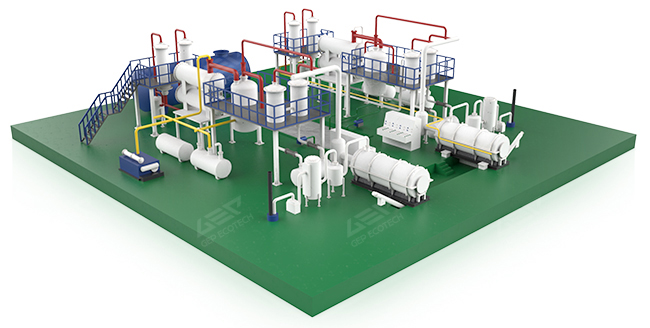
Proses pirolisis batch dan pemurnian minyak adalah proses di mana limbah ban ditempatkan dalam tungku pirolisis untuk pemanasan dan pirolisis, dan setelah minyak ban dan gas pirolisis dikumpulkan, produk padat (karbon hitam dan kawat baja) dibuang pada suhu yang lebih rendah untuk produksi berkala. Siklus produksi dari proses intermiten biasanya 24 jam, dan prosesnya meliputi langkah-langkah seperti pengumpanan, penyulingan oli, pendinginan reaktor, pembuangan terak, dan penarikan kawat baja.
Satu set peralatan penyulingan dan pemurnian minyak dengan kapasitas pemrosesan harian 15 ton biasanya berharga sekitar CNY 300.000, yang memiliki ambang batas yang relatif rendah dan cocok untuk investor dengan modal awal yang relatif kecil untuk memasuki industri ini.
Batch dan output produksi dapat disesuaikan secara fleksibel sesuai dengan kebutuhan aktual. Jika terjadi musim sepi industri, peralatan yang terputus-putus dapat dihidupkan dan dihentikan sesuai kebutuhan untuk menghindari peralatan yang menganggur dan pemborosan sumber daya.
Dengan antarmuka pengoperasian yang sederhana dan intuitif, operator dapat memulai pengoperasian setelah pelatihan singkat, sehingga mengurangi biaya tenaga kerja.
Struktur peralatan relatif sederhana, teknologinya matang dan dapat diandalkan, hanya ada sedikit suku cadang yang aus, pekerjaan perbaikan dan pemeliharaan relatif mudah, dan biaya perawatannya rendah.
Tingkat produksi minyak pada dasarnya stabil di sekitar 40%. Melalui operasi yang wajar dan optimalisasi peralatan, efisiensi produksi minyak dapat ditingkatkan lebih lanjut.
Ada beberapa metode pembuangan terak, yang dapat mewujudkan pembuangan terak otomatis tanpa pembersihan terak secara manual, dan memiliki keamanan yang tinggi; dan mengatur katup pengaman, perangkat pemantau suhu, dll. untuk mencegah terjadinya kecelakaan.
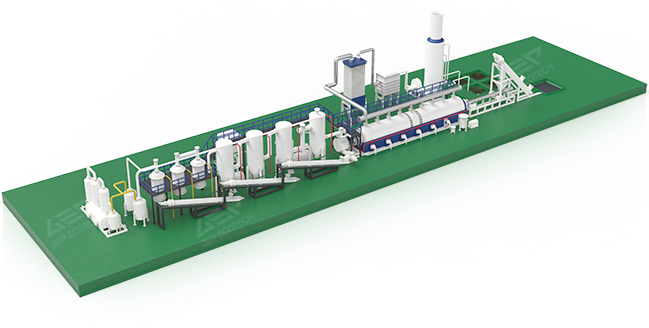
Proses pirolisis berkelanjutan menggunakan teknologi perengkahan termal untuk mengubah limbah ban menjadi minyak, gas, karbon hitam, dan kawat baja. Minyak dan gas dikondensasikan menjadi minyak pirolisis, sementara gas yang tidak terkondensasi didaur ulang untuk pemanasan. Residu padat dibuang secara terus menerus melalui sistem khusus. Proses ini ditandai dengan operasi tanpa gangguan, desain anti-kokas, penyegelan dinamis, kontrol tekanan mikro, perengkahan suhu konstan, resirkulasi gas buang, pemulihan panas limbah, serta pemantauan dan kontrol otomatis.
pengumpanan terus menerus selama 24 jam dan pembuangan terak terus menerus dapat dicapai. Terak dapat dibuang tanpa menunggu reaktor menjadi dingin. Biasanya beroperasi terus menerus selama 45-50 hari, sangat mengurangi waktu henti dan meningkatkan pemanfaatan peralatan dan efisiensi produksi. Dan kemudian meningkatkan output untuk memenuhi kebutuhan industrialisasi.
Peralatan penyulingan minyak yang sepenuhnya berkelanjutan beroperasi di bawah parameter proses yang stabil dan dapat terus menghasilkan produk bernilai tambah tinggi dengan kualitas yang konsisten, yang kondusif untuk promosi penjualan. Desain putar reaktor memungkinkan bahan baku dipanaskan secara merata, dan kerapatan, viskositas, dan indikator oli lainnya stabil dan sangat baik, menjadikannya bahan baku utama untuk memurnikan diesel non-standar; Karbon hitam juga lebih bersih, lebih baik dalam memenuhi kebutuhan pemrosesan dalam, dan memiliki nilai pasar yang lebih tinggi.
Sejumlah besar gas yang tidak dapat dikondensasi berbasis metana diproduksi selama proses penyulingan minyak, dengan nilai kalor yang mendekati nilai kalor gas alam. Selain kebutuhan untuk pemanasan bahan bakar pada tahap awal penyulingan, gas ini dapat digunakan untuk pemanasan pembakaran selama proses berlangsung. Kelebihannya juga dapat digunakan oleh boiler di area pabrik, untuk mencapai daur ulang energi.
Dilengkapi dengan sistem kontrol cerdas, lini produksi hanya membutuhkan 1-2 orang untuk mengoperasikannya, dengan otomatisasi tingkat tinggi, mengurangi kesalahan pengoperasian manual dan menghemat biaya tenaga kerja.
Peralatan ini mengadopsi struktur tertutup sepenuhnya, yang secara efektif dapat mencegah kebocoran gas limbah, limbah cair, dan residu limbah, serta mengontrol sumber polusi; Ini juga dilengkapi dengan sistem pengolahan gas buang untuk memurnikan gas buang dan mengurangi polusi.
Sistem kontrol otomatis memonitor suhu, tekanan, dll. secara real time, dan dapat memberikan peringatan dini serta penyesuaian otomatis jika terjadi ketidaknormalan, menghindari bahaya tersembunyi dan memastikan keamanan produksi.
| Tipe Kontinu (1 set 50 TPD) | Jenis Batch (4 set 15 TPD) | |
| Ban Bekas | 62T x 1900 CNY/T=117800 CNY (62T tires get 50T Rubber Granules) | 62T x 1900 CNY/T=117800 CNY |
| BBM |
Heavy Oil: 0.8T × 4900/45 CNY=87 CNY (Tire oil is used for 8 hours every one and a half months, only for pre-heating purpose) |
Batch equipment runs for 45 days and 35 days 4 Units x 0.4T x 4900 CNY=7840 CNY |
| Konsumsi Listrik | Pyrolysis: 120kW/h × 24h × 0.8 CNY/kWh=2304 CNY | Pyrolysis: 4 Units x 45kW/h x 24h x 0.8 CNY/kWh=3456 CNY |
| Shredding: 650kW/h × 12h × 0.8 CNY/kWh=6240 CNY | 0 | |
| Konsumsi Air | Hampir Tidak Ada Konsumsi | Hampir Tidak Ada Konsumsi |
| Biaya Tenaga Kerja | 6 Workers x 300 CNY x 2 Shifts=3600 CNY | 10 Workers x 300 CNY x 2 Shifts=6000 CNY |
| Memakai Suku Cadang | 300 CNY/Day | 600 CNY/Day |
| Biaya | 130331 CNY/Day | 135696 CNY/Day |
| Minyak Pirolisis | 62T × 0.4 × 4900 CNY=121520 CNY | 62T × 0.4 × 4900 CNY=121520 CNY |
| Kawat Baja | 62T × 0.18 × 2700 CNY=30132 CNY | 62T × 0.18 × 1800 CNY=20088 CNY |
| Karbon Hitam | 62T × 0.3 × 950 CNY=17670 CNY | 62T × 0.3 × 750 CNY=13950 CNY |
| Pendapatan | 169322 CNY/Day | 155558 CNY/Day |
| Untung | 38991 CNY/Day | 19862 CNY/Day |
Catatan: Data ini didasarkan pada Tiongkok sebagai contoh untuk referensi saja, dan situasi aktual di berbagai negara dan wilayah akan berlaku.
Kami memiliki basis manufaktur peralatan cerdas modern seluas 66.000 m2, dilengkapi dengan berbagai peralatan permesinan CNC berukuran besar dan menengah serta teknologi pemrosesan dan manufaktur canggih, yang dapat memenuhi inovasi penelitian dan pengembangan serta peningkatan proses set lengkap peralatan pirolisis ban dan penyulingan minyak, sekaligus memberikan efisiensi produksi yang stabil dan jaminan kualitas untuk pembuatan peralatan.
Tim kami terdiri dari para profesional dengan pengalaman industri bertahun-tahun, pengalaman proyek yang kaya, dan kemampuan teknis, terutama yang terampil dalam kontrol suhu pirolisis yang tepat. Kami telah menjalin hubungan kerja sama dengan klien dari lebih dari 70 negara di enam benua, dengan efisiensi pelaksanaan proyek yang tinggi, kemampuan pengendalian biaya yang kuat, keselamatan operasional dan operasional yang tinggi, serta kemampuan untuk memberikan hasil yang tepat waktu dengan kualitas dan kuantitas yang terjamin.
Layanan kami berkomitmen untuk memaksimalkan efisiensi seluruh peralatan pirolisis ban dan penyulingan minyak. Kami menyediakan layanan kepada pelanggan yang mencakup seluruh siklus hidup peralatan, termasuk desain solusi, panduan teknis, instalasi dan commissioning, pelatihan pengoperasian, pasokan aksesori, perbaikan pemotong, dan sebagainya, untuk menyelesaikan kebutuhan pelanggan secara tepat waktu.
From a technological perspective, both the entire tire and the cut tire can be directly put into the furnace for production. However, in practical applications, whether for transportation needs or during loading of the main furnace, it is desirable to compress the volume of waste tires as much as possible in order to load more waste tires in the limited mainstream space.
So what is more common on the market now is tire cover, which involves cutting off both sides of the tire and putting the part in contact with the ground in the middle together as the tread. This way, the original position where one tire was placed could potentially accommodate six to seven, or seven to eight tires, thus maximizing the use of the space inside the main furnace; It is also more convenient to load materials through machines or manual loading.
Dioxins are mainly caused by the presence of chlorine sources and incomplete combustion in substances. Oxygen, chlorine, and metal elements are essential conditions for the formation of dioxins. Among them, chlorine sources (such as PVC, chlorine gas, HCl) are precursors for the production of dioxins, while metal elements (such as Cu, Fe) are catalysts for the production of dioxins. When the combustion temperature is below 800℃ and the residence time of the flue gas is less than 2s, some organic matter in the combustion material will react with molecular chlorine or chlorine free radicals to produce dioxins.
The temperature of the pyrolysis process designed by our company is between 200~450℃, and the pyrolysis process is in an oxygen-deficient environment, not combustion; The waste tires of large or small vehicles used for pyrolysis do not contain organic or inorganic chlorine (additives used in tire production do not contain chlorine, and rubber is mainly made of natural rubber and synthetic rubber, both of which are non chloroprene rubber); At the same time, there are no metal cations as catalysts, so the pyrolysis process does not have the conditions to generate dioxins, which is very environmentally friendly.
Temperature: Temperature not only affects the pyrolysis process, but also the proportion of pyrolysis products. When the temperature is low, it can reduce the occurrence of secondary reactions of large organic molecules, generate more molecular chains above C5, and increase the oil content. As the temperature increases, while large molecules continue to pyrolyze, small molecules also undergo secondary polymerization reactions, resulting in an increase in olefin gases, a decrease in oil content, an increase in combustible gases. In addition, the composition of carbon black gradually decreases with the increase of temperature.
Temperature rise rate: The influence of temperature rise rate on pyrolysis is mainly reflected in the composition ratio and productivity of pyrolysis products, because the increase of temperature rise rate directly affects the mass transfer rate of pyrolysis products. Generally speaking, when the temperature rise rate is high, the pyrolysis time of waste rubber is short, and the proportion of gas in the pyrolysis product composition is relatively large, while the proportion of solid carbon black and oil is relatively small. In the case of low temperature rise rate, the pyrolysis time of waste rubber is long, and the organic matter at the beginning of pyrolysis will combine with each other to form stable solids, increasing the solid income rate.
Pyrolysis time: The longer the pyrolysis time, the longer the residence time in the pyrolysis chamber, and the more thorough the pyrolysis reaction, but the lower the pyrolysis efficiency; Moreover, the residence time in the pyrolysis chamber is relatively long, which increases secondary reactions and is not conducive to improving the quality of pyrolysis products.
Rubber size: If the size of the waste rubber is small, the heating area during the pyrolysis process is large, the heat transfer rate is fast, the pyrolysis reaction rate increases, and the pyrolysis will be uniform; If the size of waste rubber is large, the heat transfer rate is low, the pyrolysis time is long, the secondary pyrolysis reaction is easy to increase, and the pyrolysis effect will be poor. Therefore, in order to obtain better pyrolysis products, a shredder is usually used to shred the waste rubber first.